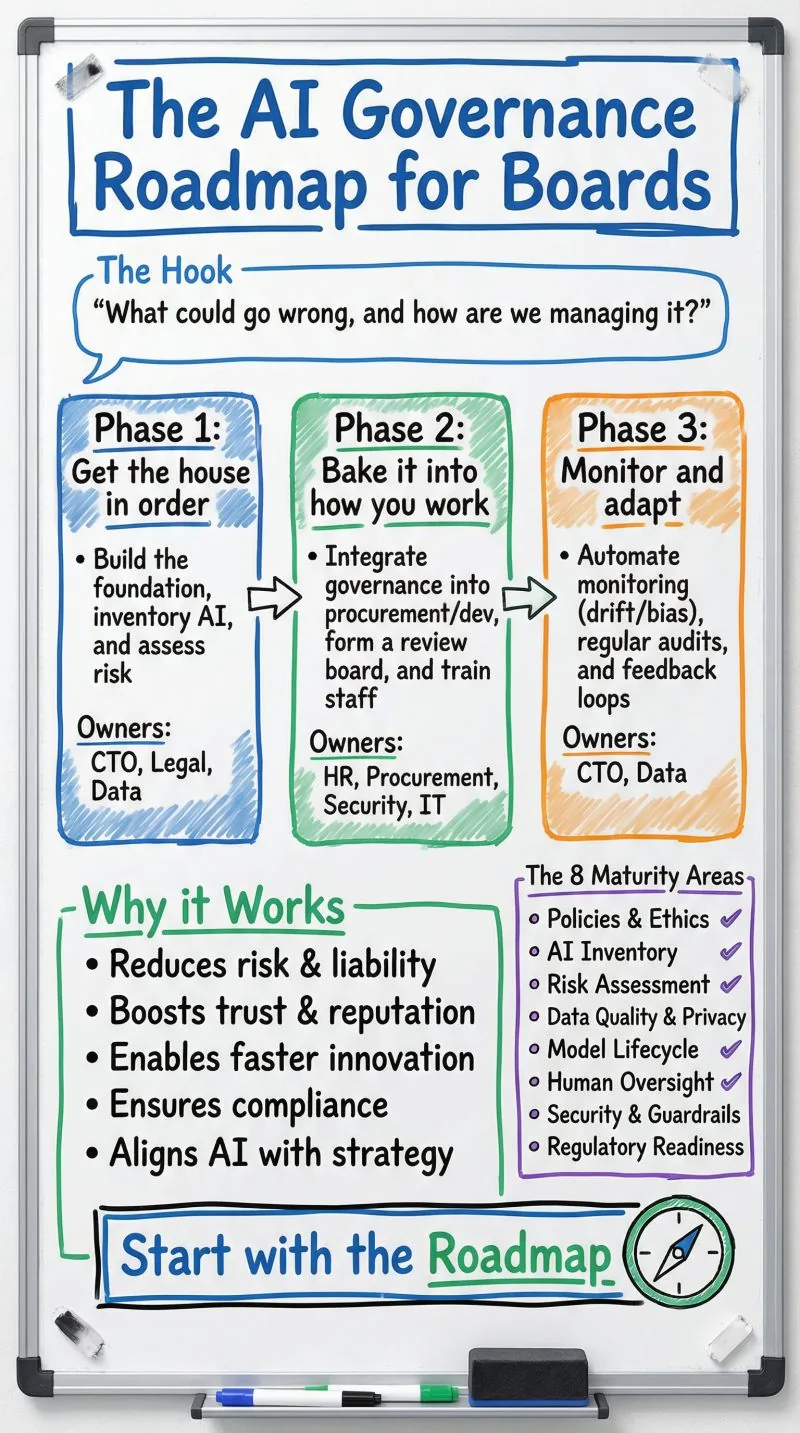
This is the framework I used to present AI risk and governance model.
Most AI governance conversations go sideways fast. They get too technical, too abstract, and too disconnected from what the CEO and board actually care about: what could go wrong, and how are we managing it?
You don’t want to walk into a board meeting with a 40-slide deck on AI ethics, model explainability, and regulatory compliance. And lose the audience by slide 5.
So I used this approach around what CEOs and boards actually need to see:
The 3-Phase AI Governance Roadmap
Phase 1
Get the house in order
Build the governance foundation. Know what AI you have, every model, every use case, every vendor. Create a consistent way to assess risk before projects go live. Owners: CTO, Legal, Data.
Phase 2
Make governance part of the development and procurement process, not a separate checklist. Form a review board for high-risk use cases. Train the organization. Owners: HR, Procurement, Security, IT.
Phase 3
Monitor and adapt
Automate the monitoring, model drift, bias, performance degradation. Run regular audits. Build a feedback loop so policies improve over time. Owners: CTO, Data.
The 8 Areas We Tracked
For each phase, we measured maturity across 8 areas:
-
Policies & ethical guidelines
-
AI inventory (what do we actually have?)
-
Risk assessment process
-
Data quality & privacy
-
Model lifecycle
-
Human oversight for high-stakes outputs
-
Security & guardrails
-
Regulatory readiness
Each area had a current state, target state, and a name next to it. No ambiguity about who owned what.
Why this worked:
The board didn't need to understand prompt injection or model explainability in detail. What they needed to see was:
-
We knew what AI systems we had
-
We had assessed the risks
-
We had a phased plan with clear owners
-
We were tracking progress against defined milestones
This approach makes the difference between a governance conversation that builds confidence and one that leaves more questions than answers.
If you're presenting AI risk to senior management or board, start with the roadmap. Add the technical depth only when asked.
■ ■ ■