
The four levels of AI adoption.
If your honest answer involves summarizing articles, drafting emails, or asking questions you used to Google, you're at Level 1 or 2. Useful, but not where the real leverage is.
If your honest answer involves summarizing articles, drafting emails, or asking questions you used to Google, you're at Level 1 or 2. Useful, but not where the real leverage is.
I know…the last thing you need is another AI article. So I'm not going to give you one. This is a diagnostic. A way to figure out where you actually are, and what's holding you back from the next level.
Four levels. Most people are stuck at Level 2. Here's how to understand the evolution of your AI journey.
Level 1: The Search/Q&A Level (Information Layer)
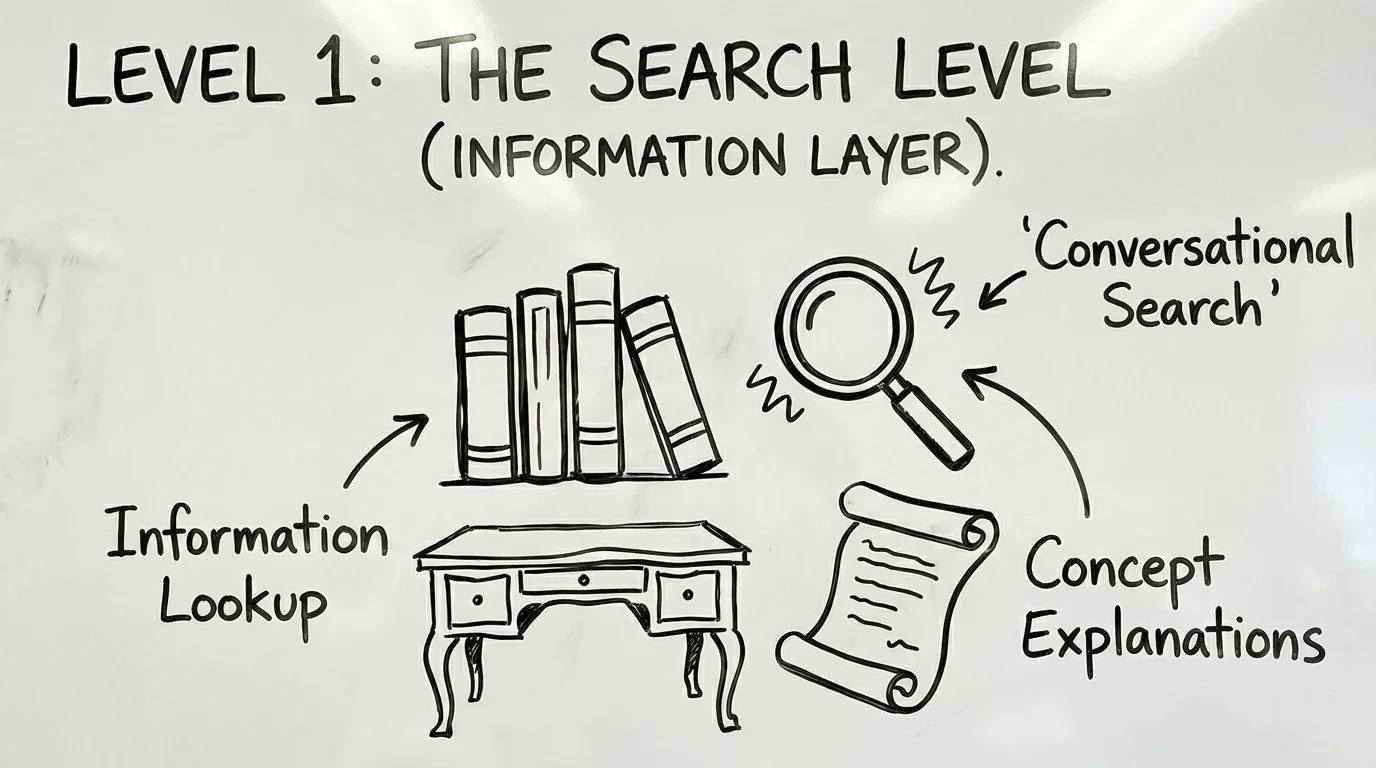
This is the most common entry point. Users treat AI as a more conversational, "smarter" version of a search engine.
Core Actions: Searching for information, explaining complex concepts, or replacing traditional Google searches.
Typical Prompts: "What does this term mean?", "How do I choose between these two products?", or "Summarize this article for me."
The Reality: Most people using AI today are still operating at this layer. It's helpful, but it doesn't change how you work.
Level 2: The Efficiency Level (Utility Layer)
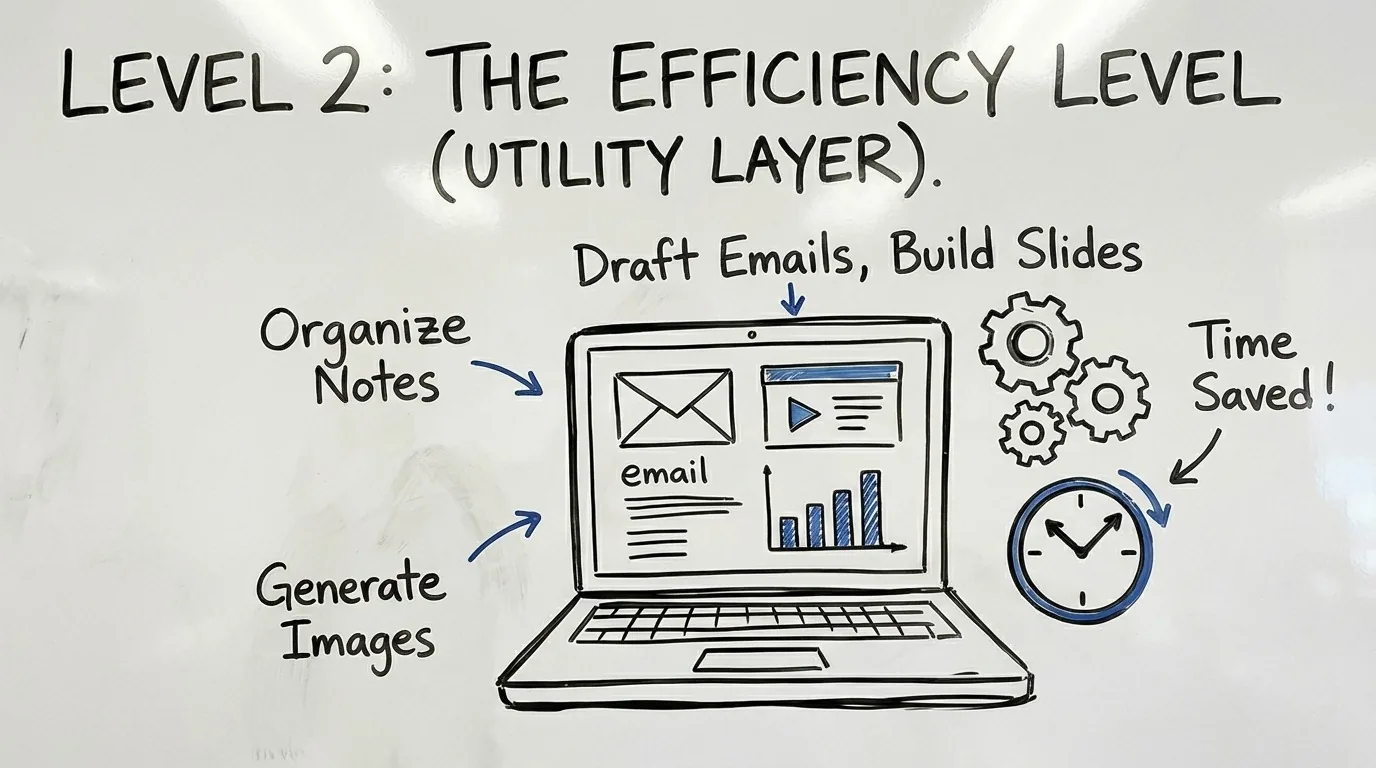
This is where you begin to see a tangible return on investment (ROI) in your daily schedule. AI acts as a high-speed production assistant.
Core Actions: Drafting emails, generating meeting minutes, organizing raw notes, creating slide decks (PPTs), and generating images.
The Impact: This is the stage where users first realize: "AI is actually quite useful." It's about saving time on discrete, repetitive tasks.
Level 3: The Decision Support Level (Thinking Partner)
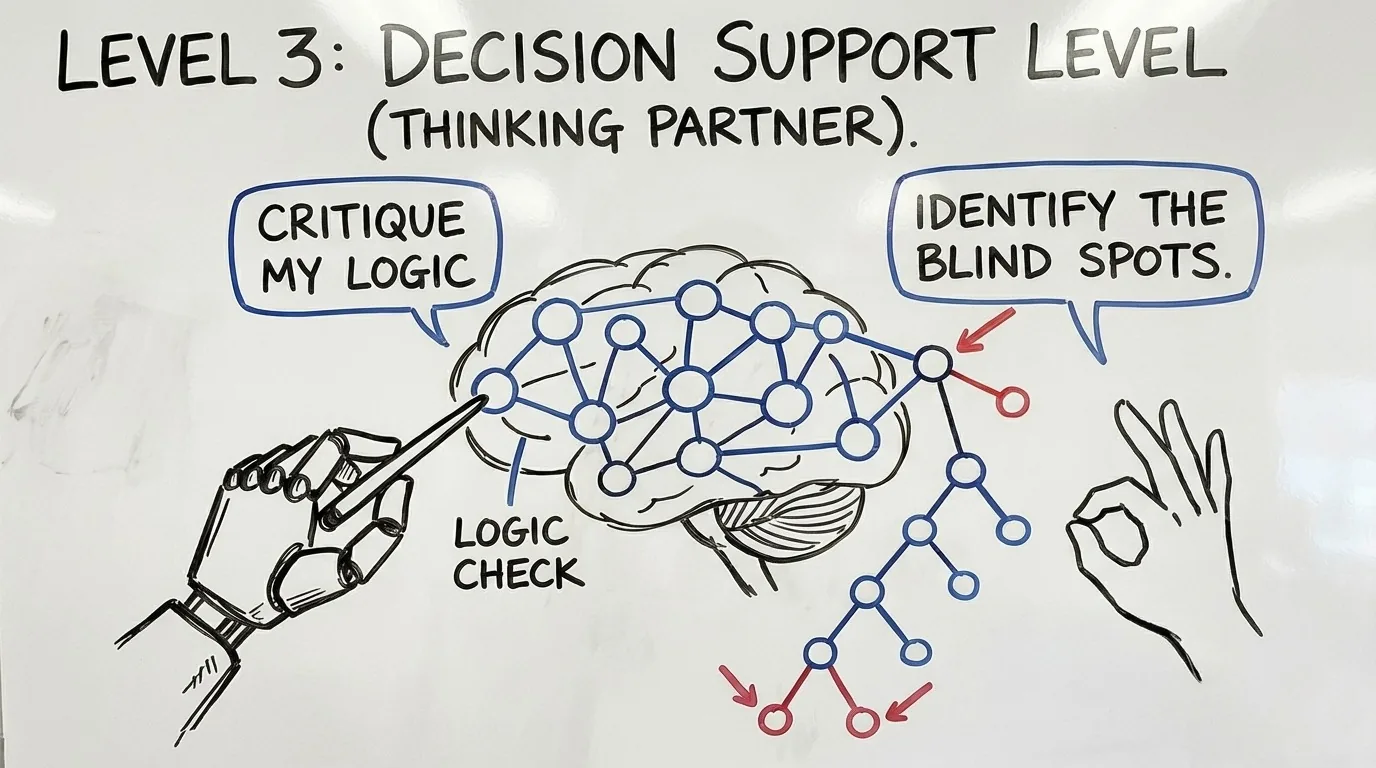
This level represents a fundamental "way of working" shift. This isn't just about saving time; it's about Decision Intelligence. At this stage, the relationship between human and AI changes from transactional to collaborative.
The "Thinking Partner" Shift: You aren't asking the AI to "write more"; you are asking it to help you "think better." You use it to stress-test your logic, find blind spots, and weigh complex trade-offs.
The Compounding Effect: By using AI as a sparring partner for your judgment, you improve the quality of your own decisions. This creates a compounding effect on your professional value over time.
Examples: Comparing three different strategic plans, breaking down an ambiguous project into actionable milestones, or identifying the best "angle" for a difficult piece of communication.
Level 4: The Workflow Level (Agentic Layer)
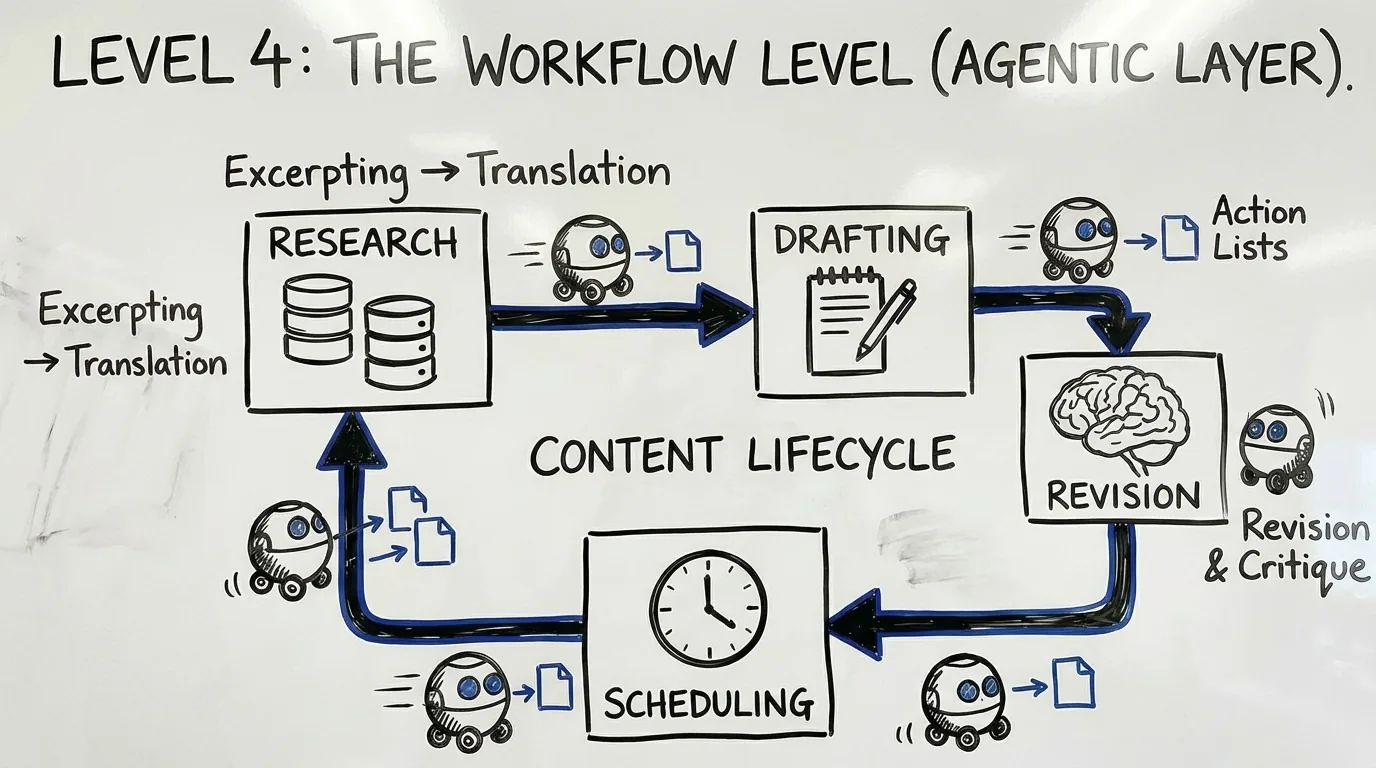
This is the defining trend of this year. We are moving away from "single-turn" questions and toward end-to-end process ownership.
The Vision: AI is no longer just a "chat tool", it is becoming your primary workstation. You hand over an entire process, and the AI manages the sequence.
Current Signals: The rise of "Agents" (like Notion Agents, Claude Cowork, or OpenClaw) points to a future where AI accompanies you through the entire work lifecycle.
Example Workflows:
-
Content: Research → Drafting → Revision → Scheduling.
-
Knowledge: Excerpting → Translation to plain language → Action lists → Follow-up reviews.
-
Operations: Meeting → Automated task distribution → Progress tracking → Reminders.
What this looks like in practice: Last week I handed my AI a rough voice memo after a meeting. It extracted action items, drafted follow-up emails, scheduled reminders, and flagged two open issues I'd forgotten to mention - all before I finished my coffee. That's Level 4.
Where Most People Get Stuck
Most professionals plateau at Level 2. Because of three human barriers:
-
Fear of over-reliance. "If I let AI do too much, I'll lose my edge." The opposite is true. The edge is knowing what to delegate.
-
Unclear processes. You can't automate what you haven't mapped. Most people don't have a clear picture of their own workflows, so they can't hand them off.
-
Prompt-first thinking. They focus on "how do I ask this better?" instead of "what decision am I actually trying to make?" Level 3 requires shifting from prompts to problems.
The jump from Level 2 to Level 3 isn't a technology upgrade. It's a mindset shift.
Strategic Advice for Professionals
Don't rush straight into Level 4. Many people struggle with complex automations or "Local Agents" not because the technology is failing, but because they haven't mastered the Level 3 logic required to structure the workflow.
I suggest this progression:
-
Master Level 2 to clear your schedule of "busy work."
-
Lean into Level 3 by making AI your constant "Thinking Partner" for high-frequency decisions.
-
Migrate to Level 4 only once you have a clear logical map of the processes you want to automate.
3 Ways to Start the "Thinking Partner" Shift Today
Post-Reading: Instead of a summary, ask the AI: "Based on these notes and my current goals, what are the 3 highest-leverage actions I should take?"
Pre-Decision: Before committing to a major decision, ask the AI: "What are the three strongest arguments against this approach, and what would I need to see to change my mind?"
Weekly Calibration: Once a week, let AI review your output and identify: "Which problems keep surfacing for me, and how can I solve the root cause?"
The true value of AI isn't what it knows - it's how it sharpens how you think.