
What’s the most important thing a CTO or CIO actually does?.
Justin, an early-career AI engineer, asked me this yesterday. My answer was simple:
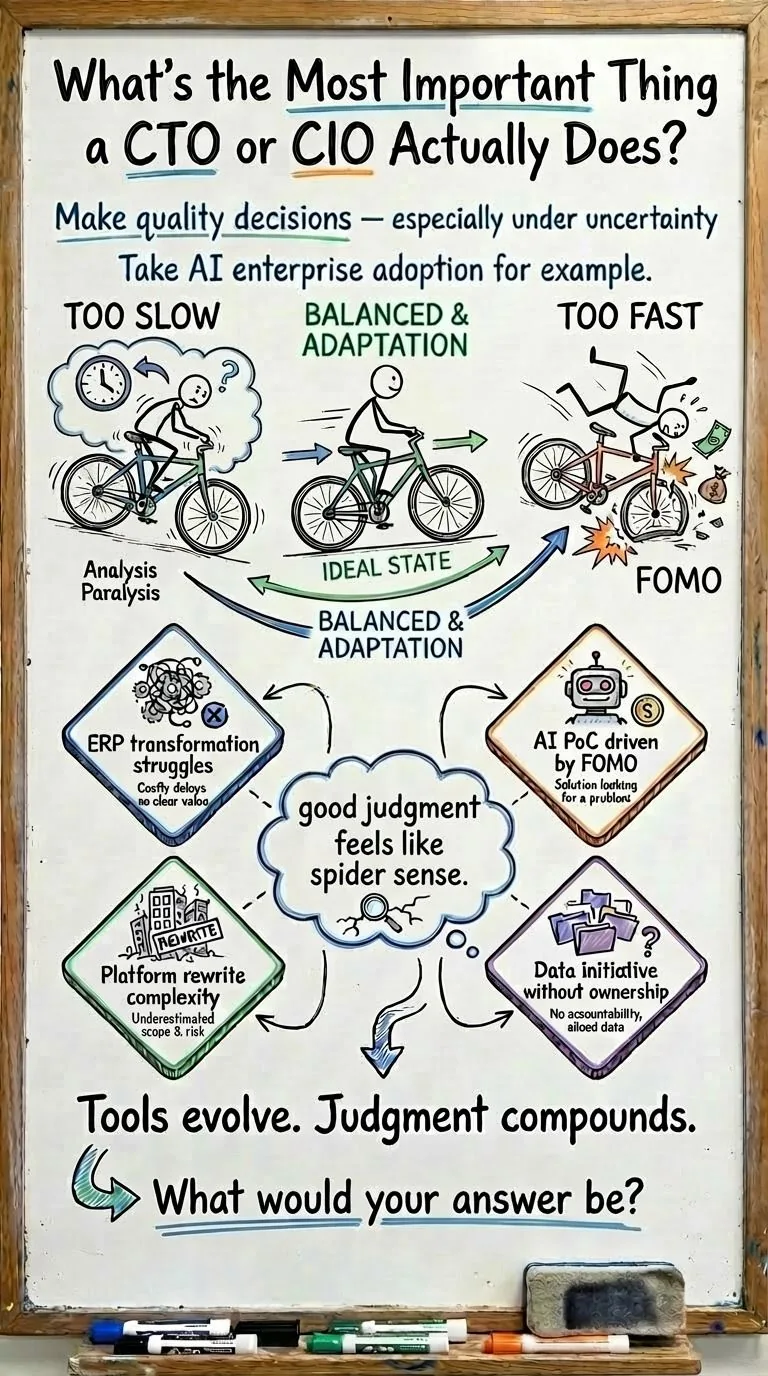
"What's the most important thing a CTO or CIO actually does?"
Justin, an early-career AI engineer, asked me this yesterday. My answer was simple:
Make quality decisions-especially under uncertainty.
In technology, volatility is the baseline. Our job isn't to eliminate uncertainty, it's to make sound decisions despite it.
For example, enterprise AI adoption is like riding a bicycle.
Go too slow, you lose balance. The organization hesitates. Competitors gain ground. Strategic momentum fades.
Go too fast, you flip over. Chasing every new model or capability consumes capital and leadership focus, only to discover it doesn't align with your data foundation, governance model, or risk tolerance.
In both scenarios, the enterprise pays the cost.
Sometimes good judgment feels like intuition…Pattern recognition is what it really is: It’s accumulated experience across multiple cycles of technology, markets, and organizational change. I’ve also learned many of these lessons the hard way.
You start seeing early signs of:
-
An ERP transformation that will struggle long before go-live
-
An AI proof of concept driven more by FOMO than durable value
-
A platform rewrite that underestimates operational complexity
-
A data initiative without real ownership
Recognizing these patterns early was a big part of how we navigated a successful exit.
Every technology decision stacks on the last. They affect what you spend, what risks you carry, and how quickly you can pivot. Some decisions open doors. Others close them before you realize it.
Making quality decisions under uncertainty is what determines whether technology becomes a growth engine or a long-term liability.
And that kind of judgment - across technology, capital, people, and risk isn't something AI can replace.
Tools evolve. Judgment compounds.