
Framework
The eight traps of AI coding
AI coding tools are creating a new category of engineering risk. Here's what I'm seeing.
April 30, 20262 min read
'Harness Engineering' - another AI buzzword. What is it, what does it do, does it matter?
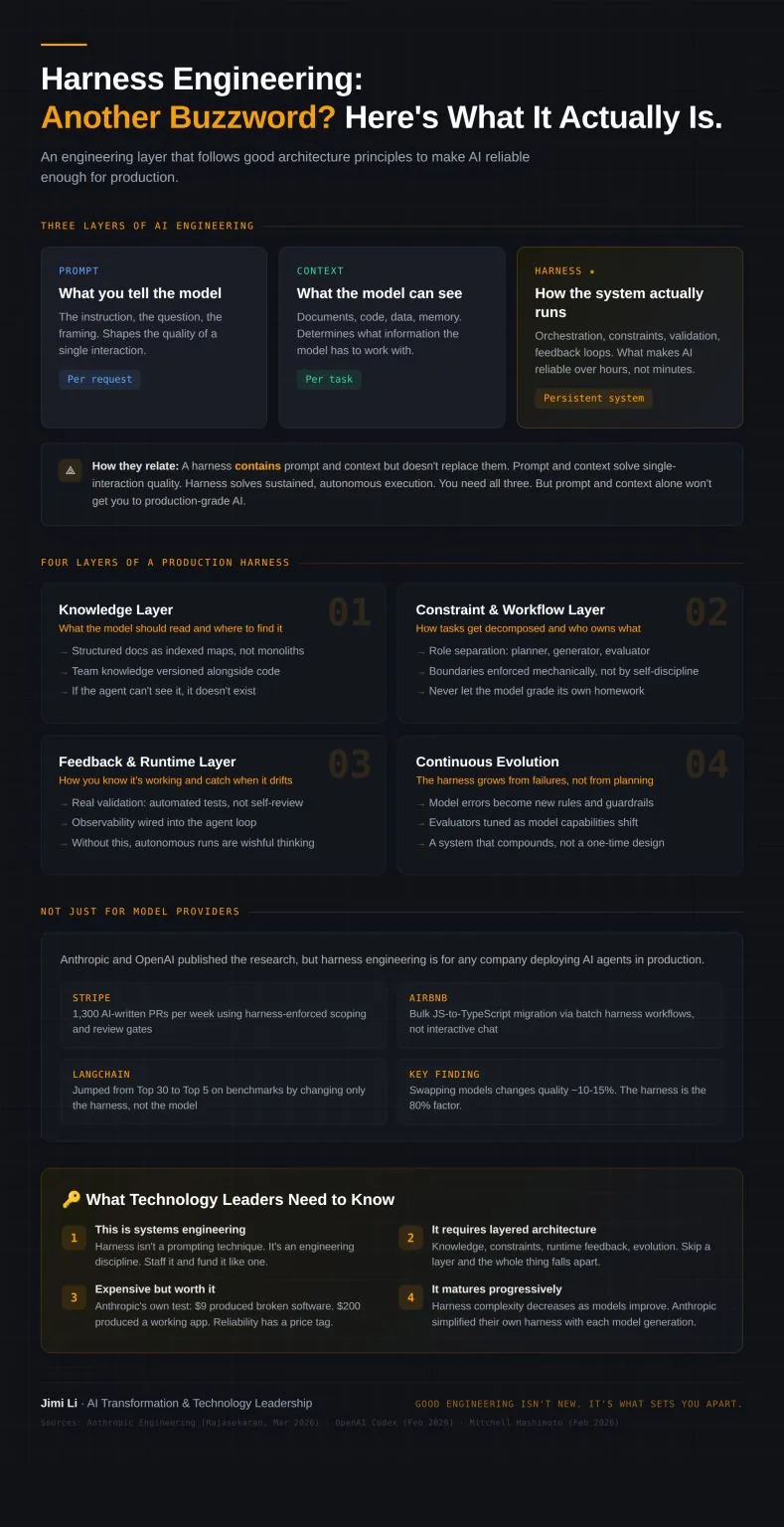
"Harness Engineering" - another AI buzzword. What is it, what does it do, does it matter?
Short answer: it's an engineering layer that follows good architecture and engineering principles to make AI reliable enough for production. Not exactly new, but absolutely important.
Longer answer:
Prompt is what you tell the model. Per request.
Context is what the model can see. Per task.
Harness is how the entire system runs. The persistent layer.
Prompt and context solve single-interaction quality. Harness solves sustained, autonomous execution. But prompt and context alone won't get you to production-grade AI.
Anthropic's engineering team ran a direct comparison. Same model, same prompt, building a 2D retro game maker.
Solo agent: 20 minutes, $9 - broken core features. Full harness: 6 hours, $200 - working application
Same exact model, the difference was the system around it.
A production harness has four layers (Infographic breakdown each one):
Knowledge — what the model should read and where to find it.
Constraints&workflow — how tasks get decomposed, who owns what.
Feedback&runtime — real validation through automated tests and observability, Test-Driven Development (TDD) is critical.
Continuous evolution — the harness grows from the loop of model error and human correction.
This isn't just for Anthropic and OpenAI.
Stripe runs 1,300 AI-written PRs per week using harness-enforced scoping and review gates. Airbnb migrated JS to TypeScript through batch harness workflows. LangChain jumped from Top 30 to Top 5 on benchmarks by changing only the harness, not the model.
The harness is the 80% factor.
Key takeaways for technology leaders:
This is systems engineering, not a prompting technique. Staff and fund it accordingly.
It requires layered architecture. Skip a layer and the whole thing falls apart.
It's expensive but worth it. Use top-tier models but keep good financial management.
It matures progressively. Don’t expect to get it perfectly the first time.
Great engineering teams are already doing this, long before harness engineering became a buzzword. Building a quickly evolving system around the model to make it reliable and trustworthy.
AI can write the code. Good engineering principles and architecture skills are what set you apart. That was true before AI. It's even more true now.