
Tool
My AI tool stack (less, but better)
As promised in my last post, this is my tool recommendation. I'm sharing the lesson I learnt and keep reminding myself:
February 15, 20261 min read
Most CIOs/CTOs are focused on AI features.
They're missing the bigger shift.
The biggest change in enterprise software isn't AI itself.
It's what AI does to applications.
For the past 20+ years, enterprise systems were built for humans:
Screens
Workflows
Clicks
That model is breaking.
We're entering a new phase where applications are no longer just tools for employees.
They're becoming execution layers for AI agents - systems that can interpret intent, make decisions, and take action across the enterprise.
This requires a fundamentally different way to design applications.
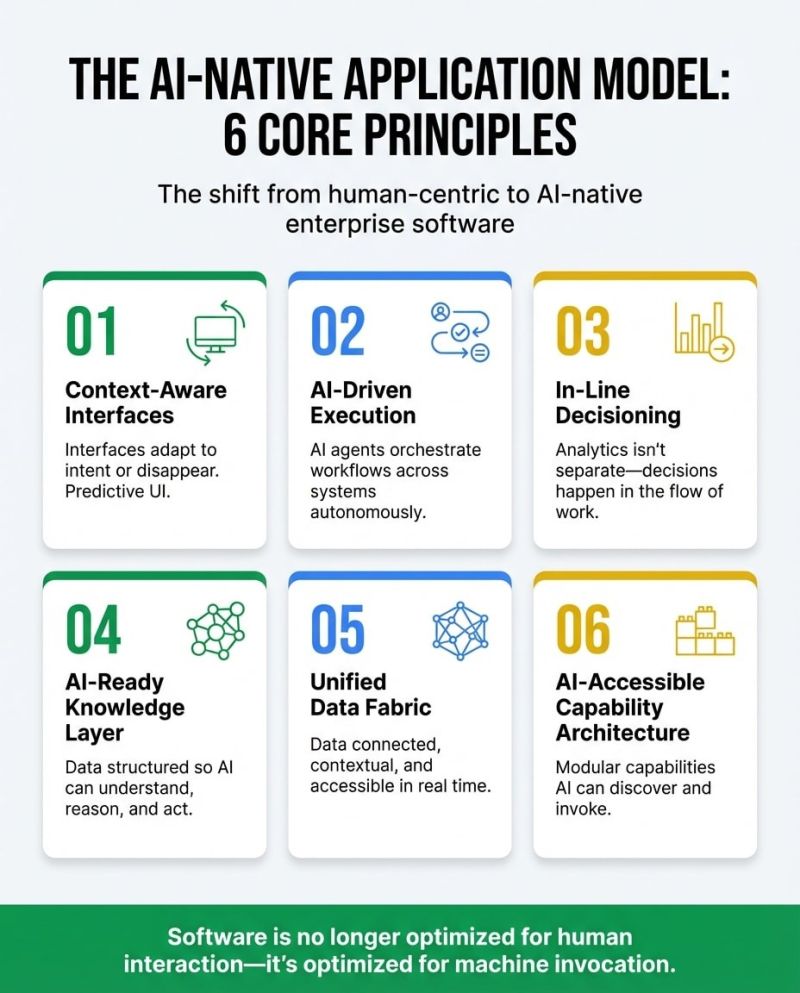
I think of it as an AI-Native Application Model, built on six core principles:
Context-Aware Interfaces
Interfaces adapt to user intent (or disappear entirely). Prompts replace clicks.
AI-Driven Execution
Workflows are no longer manually coordinated. AI agents orchestrate work across systems.
In-Line Decisioning
Analytics isn't separate anymore. Decisions happen inside the flow of work.
AI-Ready Knowledge Layer
Information is structured so AI can actually understand, reason, and act on it.
Unified Data Fabric
Data is no longer siloed. It's connected, contextual, and accessible in real time.
AI-Accessible Capability Architecture
Systems are built as modular capabilities that AI can discover and invoke.
Here's the non-obvious shift:
Enterprise software is no longer optimized for human interaction.
It's being optimized for machine invocation.
The "user" of your systems is increasingly not a person - it's an AI agent acting on their behalf.
And that changes:
How you design APIs
How you structure data
How workflows are executed
How value is created
For CIOs and CTOs, this isn't a future trend, it's a design constraint starting now.
The question is no longer:
"How do users interact with our systems?"
It's: "Can AI understand, access, and execute across them?"